
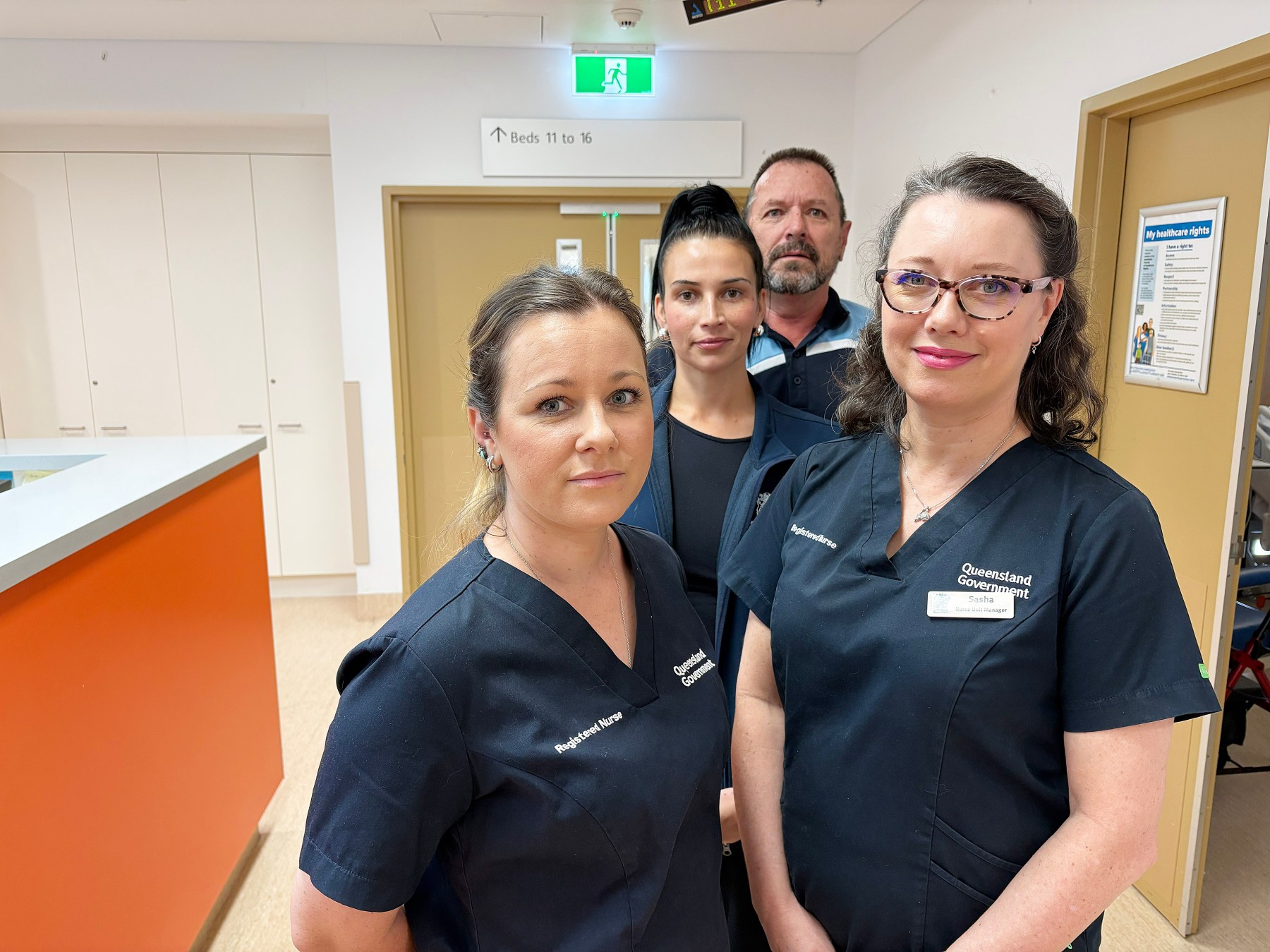
Clinicians are stepping in to reduce violence towards hospital staff.
Across Central Queensland, 248 incidents of occupational violence have been reported in public hospitals since the start of the year, which is more than two per day.
During Occupational Violence Prevention and Awareness Month, clinicians are reinforcing the importance of early identification and intervention to prevent aggression and reduce harm.
While drugs and alcohol can contribute to aggressive behaviour, many incidents are driven by underlying health conditions such as delirium, dementia or cognitive impairment.
Senior nurses Catherine Woods and Sasha Webb and their colleagues in Rockhampton Hospital’s Medical Ward have done a lot of work around helping to de-escalate these behaviours early to keep staff and patients safe.
“Hospitals can be challenging for individuals living with dementia,” Nurse Unit Manager Sasha explained.
“They’re often busy, fast-paced, filled with unfamiliar sights and sounds, and unknown faces.
“For someone experiencing cognitive impairment, this can heighten confusion and anxiety
“If we can make those patients feel comfortable and safe, they’re much less likely to use aggression or violent behaviour that can come from an underlying condition that makes them distressed.”
Clinical Nurse Catherine works across hospital inpatient teams to better understand dementia and its impacts.
“People living with dementia are not choosing to be difficult. In many cases, what we experience as aggression is fear, confusion, unmet need or self-preservation,” she said.
“Risk for staff, other patients and their loved ones grows significantly when we respond to the behaviour, not the condition.”
Catherine says dementia is one common condition that can lead to aggression, but it can also come from other conditions causing delirium.
“When we recognise fear, hallucinations, delusions, misidentification, pain, overload, and loss of control early, we can change our approach to improve our care and protect our staff.”
Tips for community members to help with a loved one in hospital or at home include:
- Approach slowly at eye levelUse the person’s name
- Speak in short sentences
- Validate emotion before task
- Offer one choice only
- Reduce noise and people
- Back off if fear rises and re-approach later.
Hospital wards have resources available to help keep patients comfortable through diversionary activities such as fidget blankets, colouring books, sensory items and other distraction activities chosen to suit the individual’s needs.