
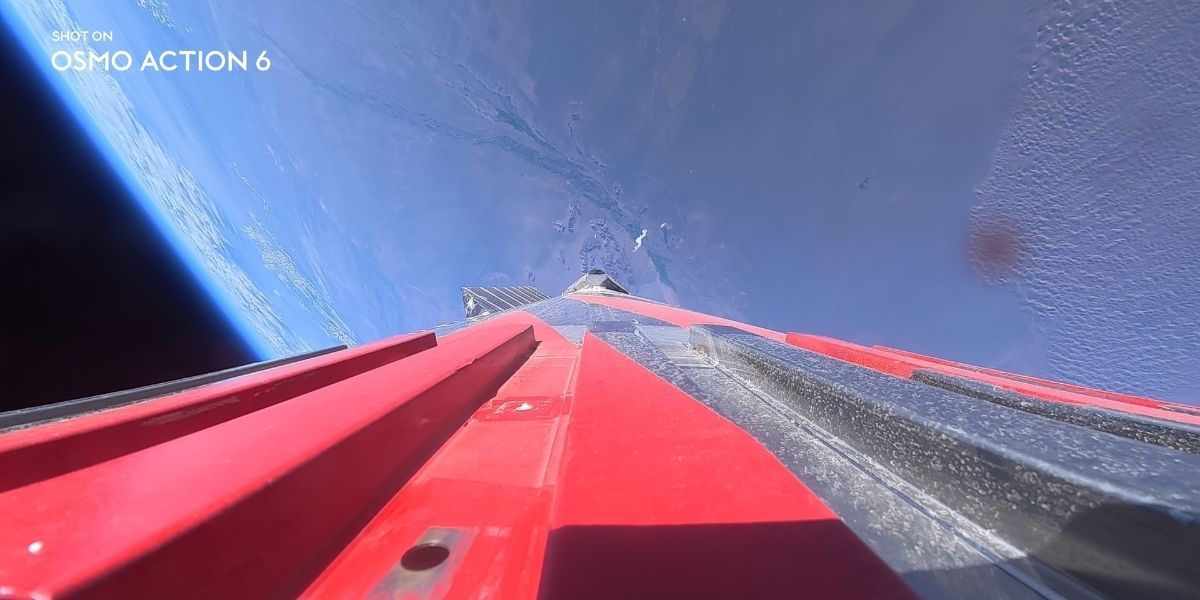
When people think about space exploration, they usually picture multi-million-dollar research equipment built behind closed doors by teams of rocket scientists. They rarely picture a standard, off-the-shelf action camera you can buy at a local electronics store.
That changed during a recent commercial rocket launch by aerospace company LandSpace. When their reusable Zhuque-3 rocket lifted off and later successfully touched back down on Earth, it carried an unusual passenger. Twelve unmodified DJI Osmo Action 6 cameras were strapped directly to the exterior of the first-stage booster.

Rather than melting down or cutting out, the pocket-sized devices recorded the entire chaotic journey. They captured the initial roar of ignition, the intense vibration of punching through the atmosphere, and the white-knuckle descent back to solid ground.
Into the Fire and the Blackout Zone
Strap a normal piece of consumer tech to a rocket, and you are asking for trouble. Aerodynamic heating during ascent and reentry sends surface temperatures soaring anywhere from 400°C to 500°C. Couple that extreme heat with relentless, high-frequency engine vibrations and violent g-loads, and most electronics usually give up within seconds.

There is also the tricky problem of the atmospheric “blackout zone”. As the rocket travels at blistering speeds, external communication completely cuts out. If a camera relies purely on live-streaming its data back to base, the footage is lost. The Action 6 bypassed this limitation entirely through onboard direct recording, safely storing high-definition files locally until touchdown.

Aerospace engineers care about this kind of durability for a very practical reason. For commercial spaceflight to become cheaper and more routine, rocket reusability is everything. Having high-fidelity, first-person footage of the booster body during flight allows engineers to properly review structural conditions and fine-tune future flights without guessing.
Keeping Things Steady in Space
Filming in space is not just about surviving heat; it is about keeping the image useful. The camera relied on a new-generation stabilisation algorithm designed to filter out the punishing high-frequency hum of the rocket body without awkwardly warping or cropping the video frame.
Lighting is another massive hurdle when you bounce between blinding high-altitude sunlight, dark shadows, and low-altitude backlighting. Packing a custom square 1/1.1-inch sensor capable of handling high dynamic range, the camera managed to catch crisp details of critical moments like grid-fin adjustments and engine burns without blowing out the highlights.

A Full Sky-to-Ground Production
The action cameras weren’t the only gear working overtime on launch day. DJI rolled out a full ecosystem of imaging tech to cover the event from every imaginable angle.

The upcoming Osmo 360 II grabbed sweeping panoramic 8K shots on-site, while the Mavic 4 Pro handled high-altitude aerial tracking. Meanwhile, the Matrice 4TD kept thermal eyes on the landing sequence, and the Osmo Pocket 4P picked up cinematic ground footage.
It turns out that capturing history doesn’t always require custom-built aerospace hardware. Sometimes, it just takes standard tech with a stubborn will to survive a trip to the edge of the atmosphere and back.